Computer vision development
From camera feed to an alert a person can act on.
Acasa Labs does computer vision development: detection, tracking, OCR, and visual search on images and live video, built into software people use. Acasa Sentinel, our hackathon build, reads number plates and finds vehicles across cameras by appearance. Kraftr turns one flat-lay photo into catalog-ready on-model imagery at up to 4K.
The problem
The model is the easy part. The pipeline around it is not.
A detector that works on a sample clip takes a weekend. A system that runs on many cameras from different vendors, keeps up in real time, survives a stalled stream, produces one useful event instead of hundreds, and puts the right evidence in front of a person is the actual project. Most computer vision work is video plumbing, tracking, deduplication, and the screen where someone decides what to do.
What we build
- 01
Detection and tracking
Find and follow people, vehicles, or objects across frames, so each one becomes a single event rather than a detection per frame.
- 02
OCR on real-world images
Number plates, labels, and documents read from imperfect photos and video, with voting across frames and fuzzy matching.
- 03
Visual search
Embeddings that find the same object across cameras or catalogs by appearance, stored in Postgres with pgvector.
- 04
Image generation with fidelity
Product imagery generated from your own photos, with the item kept exact and moderation on every output.
From production
From vision systems we built.
One sighting per vehicle
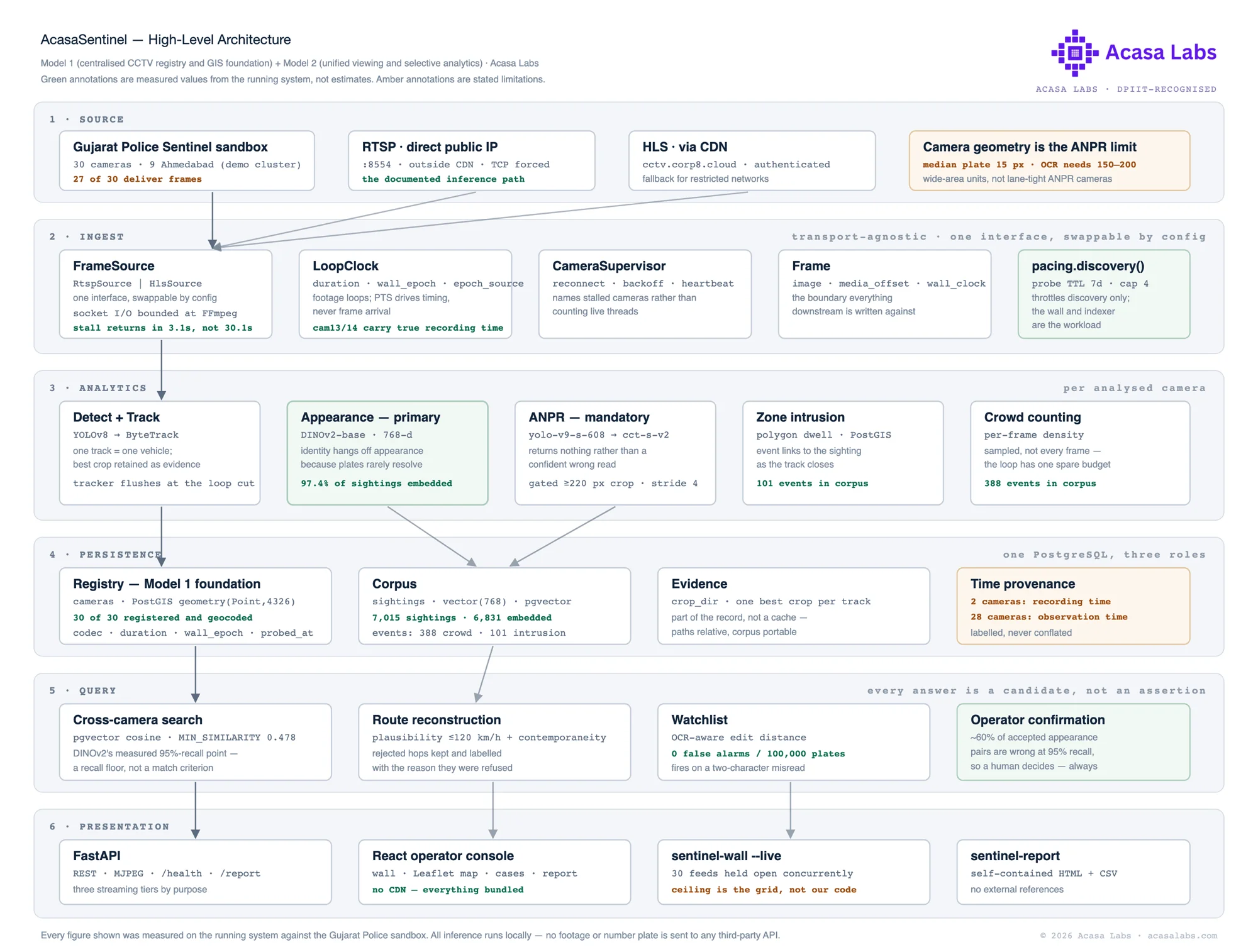
Acasa SentinelAcasa Sentinel runs YOLOv8 with ByteTrack, then plate detection and OCR per track with a multi-frame vote, so each vehicle produces one sighting instead of hundreds.
Search when the plate is unreadable
Acasa SentinelEvery sighting gets a 768-dimension DINOv2 embedding in Postgres with pgvector, so a vehicle can be found across cameras by appearance. On the hackathon sandbox, plate matching scored 24 of 24 on the proof clip.
Local inference on any hardware
Acasa SentinelAll inference runs locally, so no footage leaves the network, and the same pipeline falls back from CUDA to Apple Silicon to CPU. Ingest takes RTSP and HLS behind one interface.
The garment stays the garment
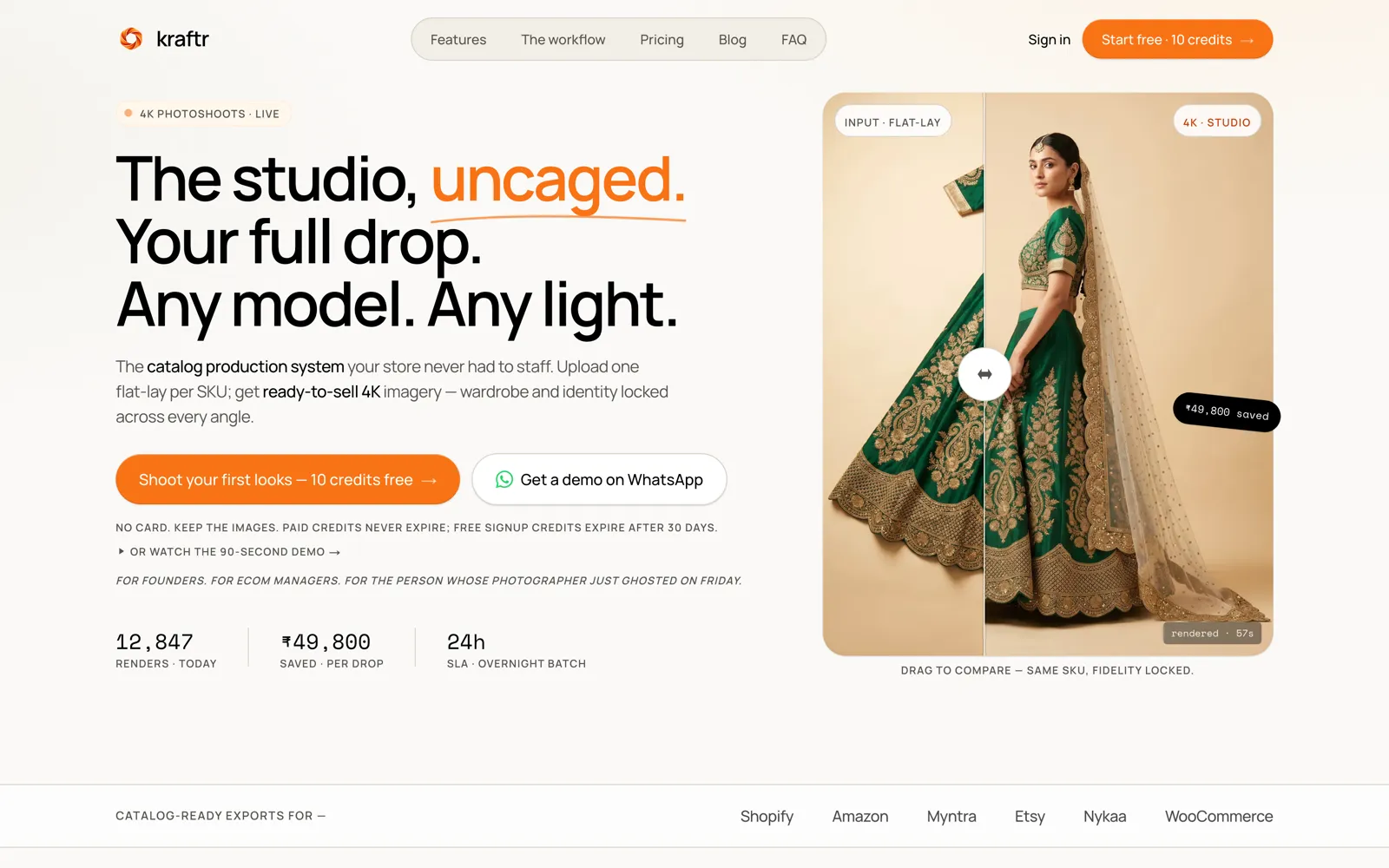
KraftrKraftr builds structured garment, model, and scene descriptions so the wardrobe and the model's identity stay locked across every angle, with output at up to 4K in ten aspect ratios.
Honest trade-offs
When vision is not the right tool
If a barcode, an RFID tag, or a sensor can give you the same answer, use it: it is cheaper and usually more accurate than a camera. Vision makes sense when the thing you need to know is only visible, when you already have cameras, or when people spend hours watching footage or sorting photos by hand. Acasa Sentinel was built and measured on a hackathon sandbox, not a city deployment, and we scope new projects with that difference in mind.
What we reach for
- Python, FastAPI
- YOLOv8, ByteTrack
- ONNX OCR models
- DINOv2 embeddings
- Postgres, pgvector, PostGIS
- FFmpeg, OpenCV
- Image generation providers
Proof
Shipped, not pitched.
01Case study
Acasa Sentinel
Give it a number plate. It returns the vehicle's route across a CCTV network.
A vendor-neutral video analytics system built for the Gujarat Police Hackathon Innovation Challenge 2026. It reads number plates, re-identifies vehicles by appearance across cameras, reconstructs routes, and raises watchlist alerts for an operator to confirm.
Operator console (web) · API
02Our product
Kraftr
One flat-lay photo becomes catalog-ready 4K on-model imagery.
An AI catalog studio for fashion and jewelry brands. Upload one flat-lay or hanger shot per SKU and get on-model imagery at up to 4K, in ten aspect ratios, sized for Amazon, Myntra, Flipkart, and Shopify.
Web · iOS · Android
Questions
Computer vision development questions we get asked.
Can you work with our existing cameras?
Usually. Acasa Sentinel ingests RTSP and HLS streams behind one interface, with a worker per camera under a supervisor, so cameras from different vendors feed the same pipeline.
Does the video have to go to the cloud?
No. Sentinel runs all inference locally, and no footage or plate is sent to a third-party API. We can deploy on your own hardware when the data must stay on site.
How accurate will it be?
That depends on your cameras, lighting, and what you need to detect, so we measure it on your footage before promising anything. Sentinel's numbers, such as 0 false alarms against 100,000 unrelated plates, were measured on a hackathon sandbox.
What happens when the system flags something?
It goes to a person. Sentinel puts watchlist hits in a queue with evidence crops, where an operator confirms or rejects each one, and every decision is kept in an audit trail.
Can you generate product images instead of analyzing them?
Yes. Kraftr turns one flat-lay or hanger shot into on-model imagery sized for Amazon, Myntra, Flipkart, and Shopify, with prompt checks and safety settings on every generation.
Computer vision development
What do you need your cameras or photos to tell you?
Send a sample clip or a handful of images and the decision they should support. We will tell you what is realistic and how we would measure it.