Scaling and growth
We don't stop at launch. We make it fast, keep it up, and get it found.
Two kinds of scaling, from one team. Technical: performance under load, reliability, and cloud and AI costs that grow slower than usage. Growth: search, AI answers, and analytics, so more of the right customers find the product and you can see what they do.
What we build
- 01
Performance under load
We find what is slow with real measurements, then fix it: queries, queues, caching, and the code paths that sit between a user and an answer.
- 02
Reliability you can see
Monitoring, alerts, and background jobs that recover on their own, so an outage is a page you get, not a customer email.
- 03
Costs that grow slower than usage
Cloud, storage, and AI model bills tracked per feature and per call, then cut where the spend does not earn its keep.
- 04
Growth: found, chosen, measured
Search and AI-answer setup, landing pages built for what buyers search, and analytics that show which pages and features turn visitors into customers.
What we reach for
- Prometheus, Grafana
- Sentry, PostHog, Google Analytics 4
- Redis, BullMQ, Postgres job queues
- CDN caching on Cloudflare
- Schema.org JSON-LD, sitemaps, llms.txt
- Google Search Console
From production
How we scale, from systems we run.
Measure every stage first
Options trading platformOn a private options trading platform, latency is instrumented across 12 stages with exact percentile reservoirs, exported to Prometheus and Grafana with alert rules. You cannot make fast what you cannot see.
Jobs that recover on their own
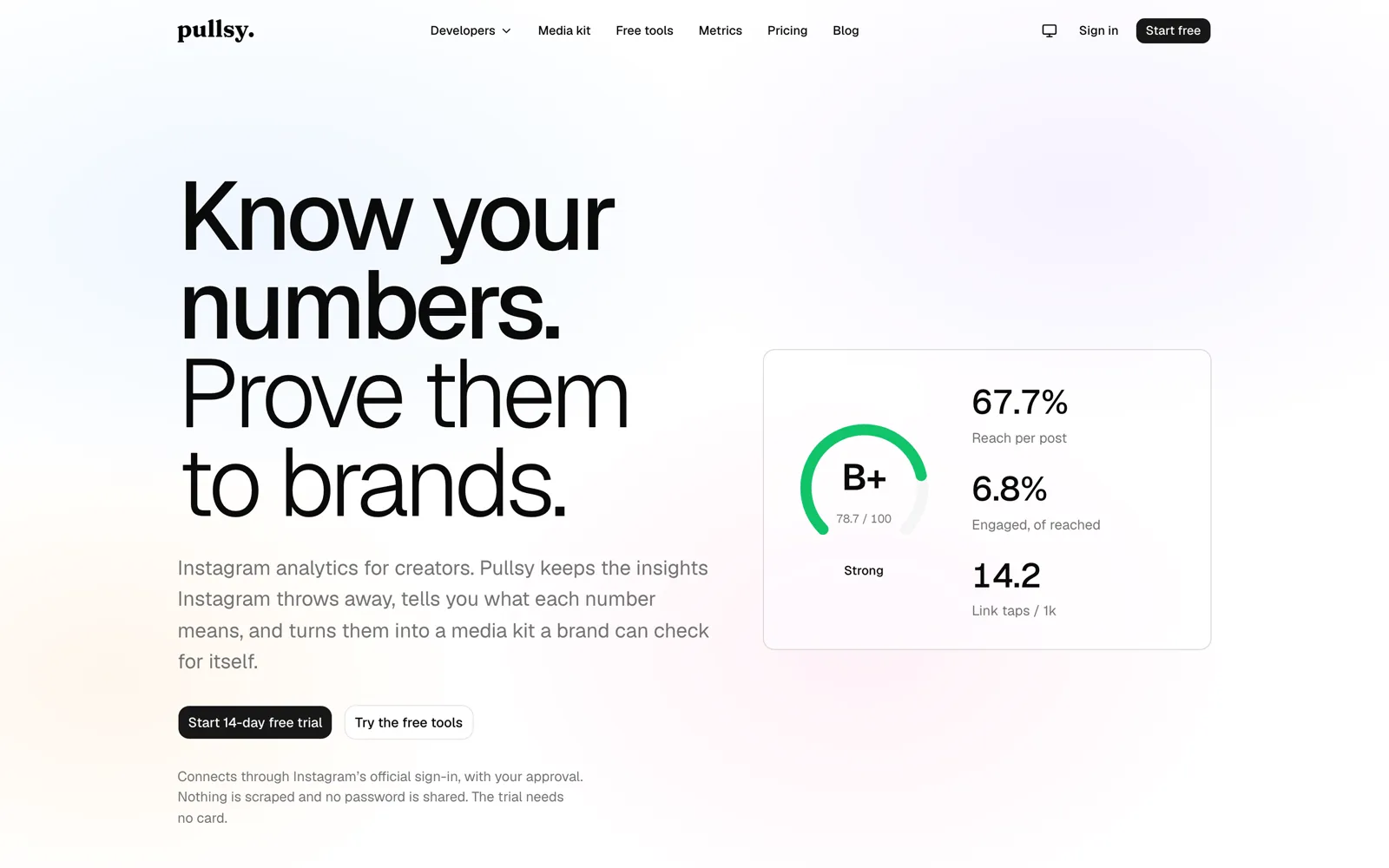
PullsyPullsy's scheduler recovers crashed jobs from missed heartbeats, and per-connection locks mean one account never syncs twice, however many workers are running.
Let the CDN do the work
KraftrKraftr keeps signed image URLs byte-identical within a day, so browsers and CDNs actually cache them, and workers write heartbeats every 10 seconds into a liveness view in the admin.
Growth you can measure
Siona JewelsSiona Jewels has structured data on every page, a robots.txt that welcomes AI crawlers by name, and GA4 events for design views, shortlists, and leads, with no personal details sent.
Honest trade-offs
When you should not scale yet
If you have a handful of users, the bottleneck is finding the next customer, not the database. Spend on growth first and keep the system simple. Spend on technical scaling when you can measure the pain: slow pages users complain about, jobs that fail under load, or a cloud bill growing faster than revenue.
Proof
Shipped, not pitched.
01Client work
Options trading platform
Microsecond market-data handling for index options, with risk checks that never sleep.
A private trading platform for index options on an Indian exchange: tick capture, research and backtesting, paper and live execution, and a control dashboard. Built for a client's internal use; details are anonymized.
Trading engine · Realtime gateway · Web dashboard
02Our product
Pullsy
Instagram analytics that keep the numbers Instagram throws away.
Analytics for creators. Pullsy keeps insights Instagram discards after about 90 days, explains what each number means, grades the account, and turns it into a media kit a brand can verify.
Web · iOS (native SwiftUI) · REST API
03Our product
Kraftr
One flat-lay photo becomes catalog-ready 4K on-model imagery.
An AI catalog studio for fashion and jewelry brands. Upload one flat-lay or hanger shot per SKU and get on-model imagery at up to 4K, in ten aspect ratios, sized for Amazon, Myntra, Flipkart, and Shopify.
Web · iOS · Android
04Client work
Siona Jewels
A jewellery manufacturer's catalogue that buyers find on Google and in ChatGPT, and that turns a design number into a lead.
Siona Jewels is a fine jewellery manufacturer in Mumbai selling to retailers and private-label brands in India, the US, Canada, and the UAE. We built their B2B catalogue site, the CMS behind it, the email automation that routes every enquiry to sales, and the search and AI-answer setup that gets them found.
Web · CMS admin


How we work
Build, then keep building.
- 01
Sit with the operation
We watch how the work actually happens. Inboxes, tools, handoffs. No workshop theater.
- 02
Ship the product
A working web or mobile app. Something your people can open on Monday, not a prototype graveyard.
- 03
Wire the automation
Agents and workflows on the product and the systems you already have.
- 04
Stay on it
We do not vanish after launch. The operation changes. The software should too.
Questions
Scaling questions we get asked.
Can you scale an app you did not build?
Yes. We start with a short audit: measurements of where the time and the money go, the error reports, and the code paths that matter. Then we fix the worst of it first and tell you what can wait.
How do you find what is slow?
With measurements, not guesses: tracing and timing on the slow paths, query plans for the database, and queue depth for background work. On the trading platform we built, every stage of the hot path is timed.
Can you reduce our cloud or AI bill?
Usually. We record cost per feature and per model call, then cut what does not earn its keep: oversized instances, uncached images, and model calls that read far more than they need to. Retrieval that narrows what the model reads is often the biggest saving on an AI bill.
What does growth scaling include?
Search and AI-answer setup, landing pages for what your buyers search, structured data, and analytics that show which pages and features convert.
Do we need both kinds of scaling?
Not at once. Early products need growth more than performance. Products with real traffic usually need both, and one team doing both means the fast page is also the one that ranks.
Scaling and growth
Tell us what you need built.
Thirty minutes on how the work happens today. You leave with a written plan: scope, timeline, and a number.