Application monitoring and reliability
Hear about the problem before your customers do.
Application reliability means the product keeps working when traffic spikes, a third-party API fails, or a worker crashes, and someone is told when it does not. Acasa Labs builds the monitoring, the alerts, and the self-recovering background jobs that make that true. Pullsy's scheduler recovers crashed jobs from missed heartbeats, and Kraftr's workers report their liveness every 10 seconds.
The problem
You find out about outages from customers.
A sync job died on Friday night and nobody noticed until Monday. A payment provider started returning errors and the app swallowed them. The queue backed up and orders sat unprocessed for hours. None of these show up as a red screen. They show up as an angry email, and by then the damage is done. Reliability is mostly the unglamorous work of making failures visible and recoverable.
What we build
- 01
Monitoring and alerts that matter
Dashboards and alert rules on the things that hurt customers: errors, latency, queue depth, failed jobs, and stalled integrations. Not a wall of graphs nobody reads.
- 02
Background jobs that recover
Heartbeats, leases, retries with backoff, and locks, so a crashed worker's job is picked up again and never runs twice.
- 03
Integrations that fail gracefully
Third-party errors mapped to the right response: retry later, ask the user to reconnect, or alert a person.
- 04
Nothing lost on the way
Writes saved before notifications are sent, so a failed email or webhook is logged and retried instead of losing the record.
From production
Reliability work from systems we run.
Crashed jobs come back
PullsyPullsy's Redis queue uses atomic move-with-ack and a delayed-retry set, and a scheduler recovers crashed jobs from missed heartbeats. Per-connection locks mean one account never syncs twice.
Third-party errors, handled
PullsyMeta's error codes are mapped to backoff with jitter, capped at 30 minutes, and re-authorization is handled as its own state rather than a failure.
Liveness you can see
KraftrKraftr's workers write heartbeats every 10 seconds, feeding a liveness view in the admin, across seven queues for generation, model builds, scenes, jewelry libraries, video, and batch polling.
Alerts and a kill switch
Options trading platformThe trading platform exports latency to Prometheus and Grafana with alert rules, and a kill switch stops new risk without dropping the data stream.
Honest trade-offs
When you do not need an on-call rotation
A small product does not need a full reliability programme. It needs error tracking, a few alerts on what would hurt customers, and jobs that retry. That is most of the benefit for a fraction of the effort. We add more only when the business depends on the system being up at every hour.
What we reach for
- Sentry
- Prometheus, Grafana
- PostHog
- Redis queues, BullMQ
- Postgres job queues with leases
- Uptime checks
Proof
Shipped, not pitched.
01Our product
Pullsy
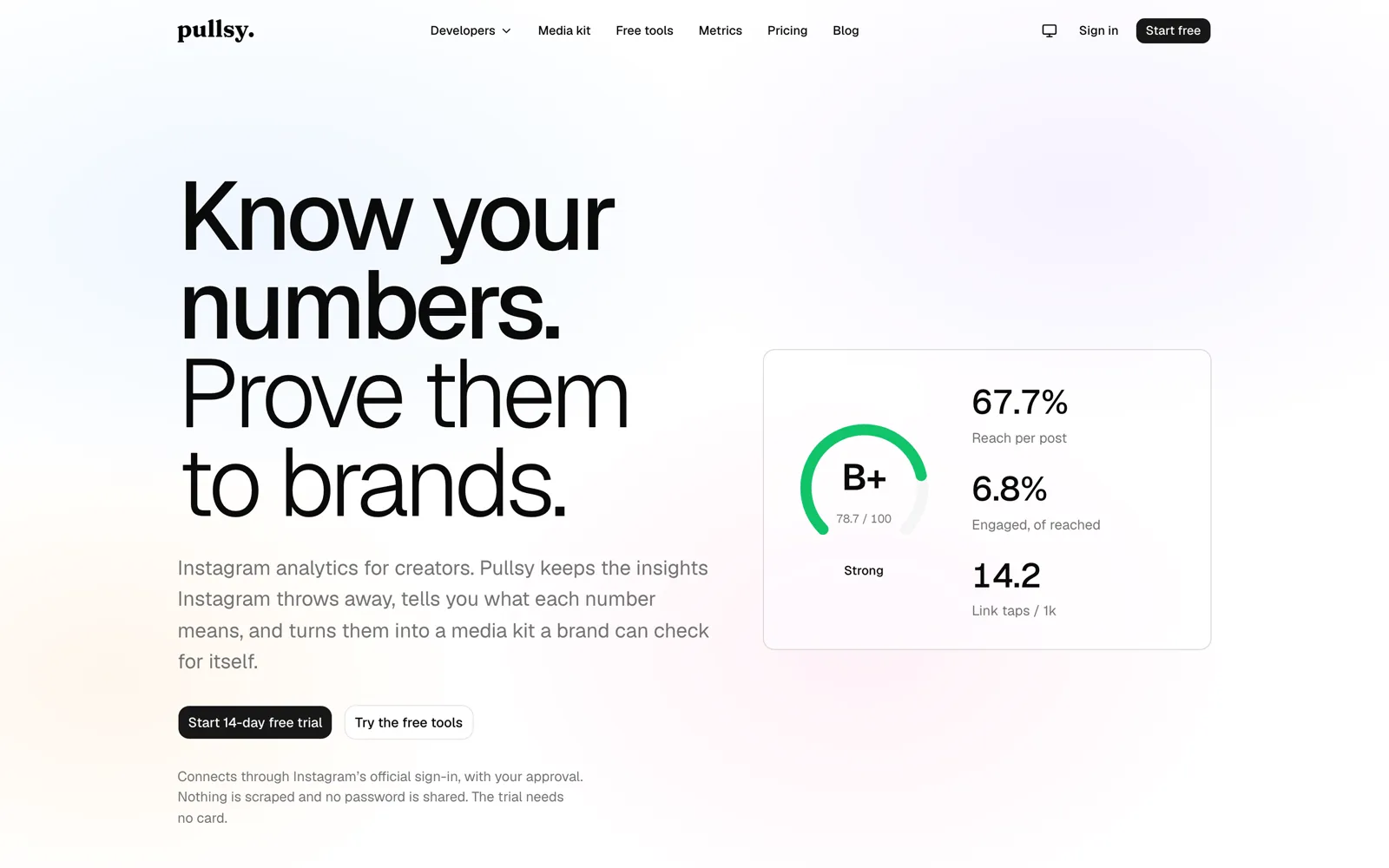
Instagram analytics that keep the numbers Instagram throws away.
Analytics for creators. Pullsy keeps insights Instagram discards after about 90 days, explains what each number means, grades the account, and turns it into a media kit a brand can verify.
Web · iOS (native SwiftUI) · REST API
02Our product
Kraftr
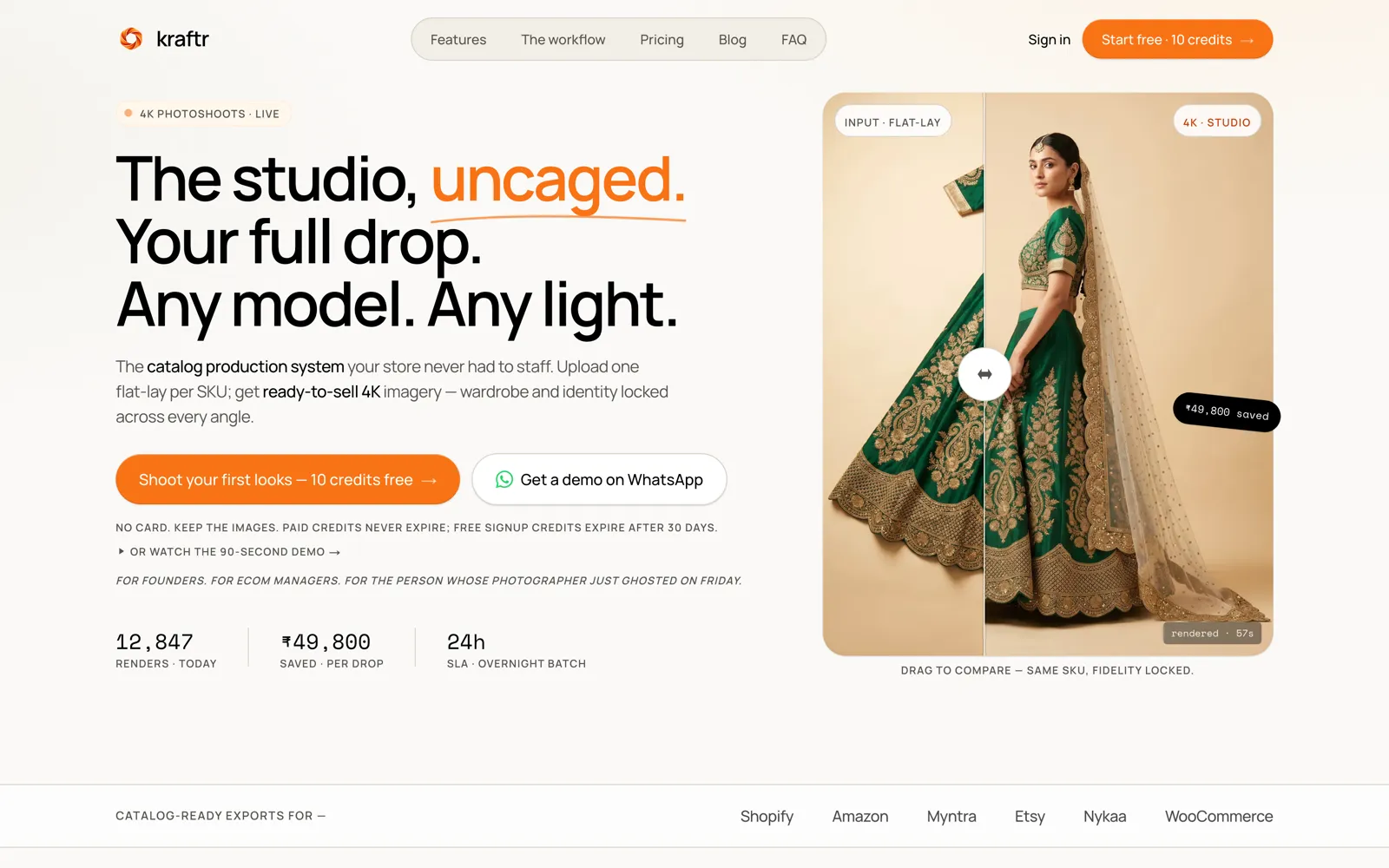
One flat-lay photo becomes catalog-ready 4K on-model imagery.
An AI catalog studio for fashion and jewelry brands. Upload one flat-lay or hanger shot per SKU and get on-model imagery at up to 4K, in ten aspect ratios, sized for Amazon, Myntra, Flipkart, and Shopify.
Web · iOS · Android
03Client work
Options trading platform
Microsecond market-data handling for index options, with risk checks that never sleep.
A private trading platform for index options on an Indian exchange: tick capture, research and backtesting, paper and live execution, and a control dashboard. Built for a client's internal use; details are anonymized.
Trading engine · Realtime gateway · Web dashboard
04Client work
Siona Jewels
A jewellery manufacturer's catalogue that buyers find on Google and in ChatGPT, and that turns a design number into a lead.
Siona Jewels is a fine jewellery manufacturer in Mumbai selling to retailers and private-label brands in India, the US, Canada, and the UAE. We built their B2B catalogue site, the CMS behind it, the email automation that routes every enquiry to sales, and the search and AI-answer setup that gets them found.
Web · CMS admin

Questions
Reliability and monitoring questions we get asked.
What should we monitor first?
The things a customer would notice: error rates, slow requests, failed background jobs, queue depth, and whether each third-party integration is working. Everything else can wait.
Can you add monitoring to an existing app?
Yes. Error tracking and basic alerts can usually be added without changing how the app works, and they show quickly where the real reliability problems are.
How do you stop a job from running twice?
With locks and leases: a worker claims a job for a limited time, and if it dies, the job is released and picked up again by someone else. Pullsy and SigmaCPM both work this way.
Who gets the alerts?
Whoever you choose: your team, us, or both. We set up the alerts to go where someone will actually act on them.
Do you look after the system after the work is done?
We can. Some clients keep us on to watch the alerts and fix what they find; others take it over with the runbooks we write.
Application monitoring and reliability
Tired of hearing about outages from customers?
Tell us what broke last. We will tell you what we would monitor, what we would make recoverable, and what it would take.